Spin Systems
Introduction
The purpose of this page is to collect information on various spin systems. We are not going to talk about multiplets that can be analyzed following first-order rules but about higher-order multiplets. Usually, these are tackled using spectral simulation. But sometimes a trial-and-error approach can take a lot of time, if you don't have suitable starting values. In such cases, an analytical approach could help to save time by providing suitable starting values. But remember:
- first consider the symmetry of the spin system based on your structural model; if there are chemically equivalent but magnetically nonequivalent spins, then the spin system will constitute a higher order spin system;
- the symmetry of the spin system will dictate the rules that should be applied in order to analyze the multiplet manually; a higher order spin system may give rise to a spectrum that is apparently simple ("deceptively simple"), but it should not be analyzed as a simple spectrum!
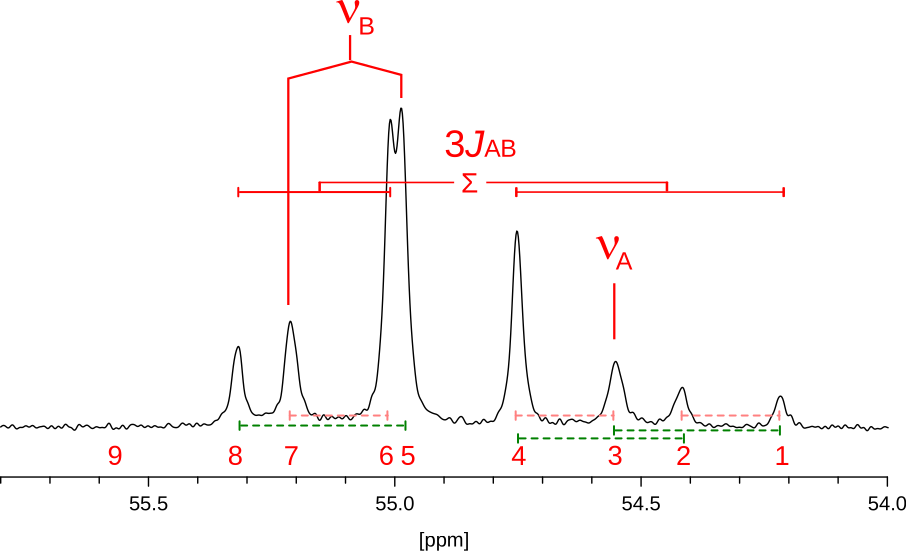
The following pages often contain forms that aid in the analysis of multiplets. The solutions can be verified by using the chemical shifts and coupling constants as starting point for a simulation. Often these simulations are also embedded in the pages as images in SVG format (scalable vector graphics). If you are interested in getting at the embedded SVG graphics, you can find some information on this page: SVG
Two Spin System
| AB system | general | analysis | simulation |
Three Spin Systems
| ABX system | general | analysis of AB part | simulation of AB part |
| analysis of X part | simulation of X part | ||
| AA'X system | general | analysis of X part | simulation of X part |
| AB2 system | general | analysis | simulation |
References
- Pople, J. A., Schneider, W. G., Bernstein, H. J. High-Resolution Nuclear Magnetic Resonance; McGraw-Hill, New York, 1959.
- Haigh, C.W. J. Chem. Soc. (A) 1970, 1682, DOI: 10.1039/J19700001682