
AB Spin System: General Information
Appearance of an AB NMR Spectrum
 |
 |
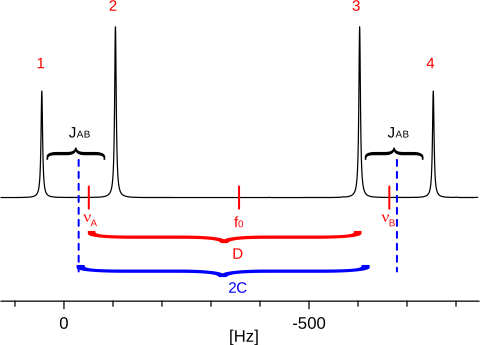
- The spectrum of an AB spin system consists of 4 peaks.
- The analysis gives |JAB|, and D (difference of chemical shifts of A and B, in Hz).
- JAB appears two times in the spectrum (property of repeated spacings), as outer separation of peaks.
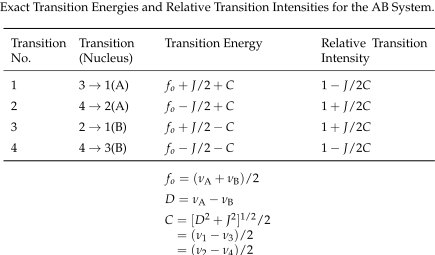
- The intensities should correspond to the intensity sum rule:
I1 = I4 , I2 = I3 ; I1 + I2 = I3 + I4 - Consequences of the AB character are:
- the intensity ratio of stronger (inner) peaks to weaker (outer) peaks depends on the ratio JAB to D ("roof effect"), i.e., the multiplets "lean" towards each other:
I2 / I1 = I3 / I4 = (ν1 - ν4)/(ν2 - ν3) - the true chemical shifts of A and B are no longer at the center of the A- or B-doublet, but shifted towards the stronger inner peak. (Actually, the doublets move away from the center of gravity f0) The error in chemical shifts, if picked from the centers of the doublets, corresponds to (2C-D)/2, see example below.
- the intensity ratio of stronger (inner) peaks to weaker (outer) peaks depends on the ratio JAB to D ("roof effect"), i.e., the multiplets "lean" towards each other:
- The ratio D/J is used to draw the line between AB and AX spin systems: if the ratio is less than 10, the spin system is called AB, if the ratio is greater than 10, the spin system is called AX, although intensity deviations may still be visible (for D/J = 10, I2/I1 = 1.16).
- The above expressions for the transition energies and intensities are used on the page on AB spectrum simulation.
- The analysis of an AB NMR spectrum can be performed interactively on the page on AB spectrum analysis.
Additional Information on the AB NMR Spectrum
- A series of nice examples is featured on Hans Reich's website, while a useful method to find the "leaning partner" B, if A is given, is illustrated on Stans Blog.
However, I disagree in one point: I would call the AB pattern neither a quartet nor a quadruplet, but two doublets, because those are the multiplets they will form if the external magnetic field is sufficiently strong. For the same reason, no one would call the 1H NMR spectrum of ethanol an octet or octuplet, but a singlet and quartet and triplet. (N.B. I was not the cause of the revision mentioned on Stans Blog!) - Another nice example of how the AB doublets are shifted away from their common center of gravity and hence from the "true" chemical shift position is provided by the 119Sn{1H} NMR spectrum of Jens Henning's unysmmetrical 1,2-distanna-cyclobet-3-en (compound 8 in ref. [4]). The 186.50 MHz NMR spectrum consists of several isotopologues:
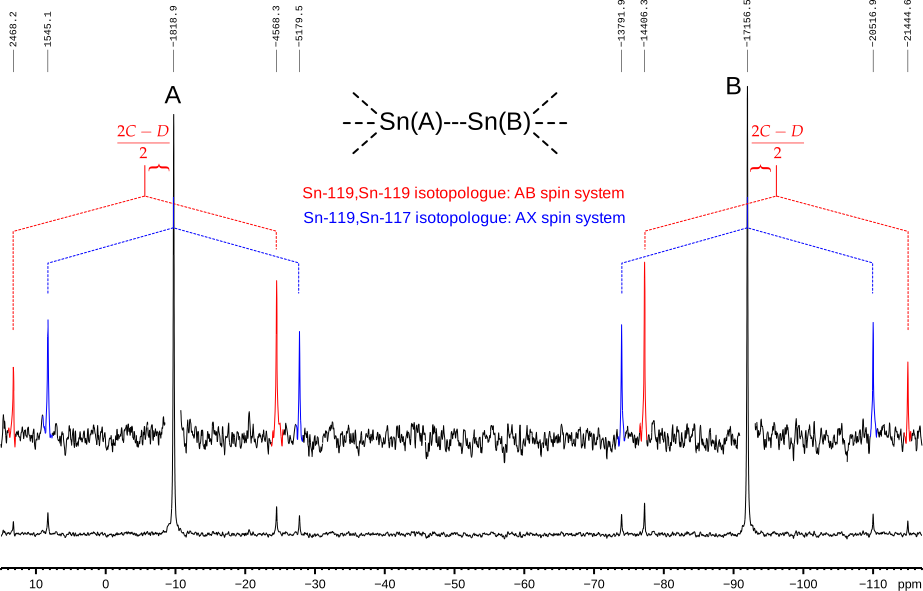
- there are two strong peaks corresponding to the situations that there is one 119Sn nucleus at the A (-9.8 ppm) or B (-92.0 ppm) positions
- if, in addition to 119Sn at A, there is a 117Sn nucleus present at B, a doublet of satellites appears symmetrically about A, and vice versa for 119Sn(B) with a symmetrical doublet of satellites caused by 117Sn at A.
(In principle, there could be a small isotope shift that would displace the center of the doublet from the position of the uncoupled 119Sn, but this effect is too small in the present case).
Because 119Sn and 117Sn are different nuclei, the 119Sn,117Sn isotopologue constitutes a heteronuclear AX spin system.
(If the J(119Sn,117Sn) is sufficiently great, even this heteronuclear system could form an AB spin system at low magnetic fields, see ref. [5] for an example.) - in contrast, if the second nucleus is also 119Sn, the spin system is homonuclear and forms an AB spin system, because J(119Sn,119Sn) = 7037.4 Hz and D = 15338.0, hence D/J = 2.18, smaller than 10. The difference between the center of the doublet and the true chemical shift is (2C-D)/2 = 768.7 Hz or 4.1 ppm. This AB spectrum provides the default values on the page on AB spectrum analysis.
References
- Günther, H. NMR-Spektroskopie, Eine Einführung. Georg Thieme Verlag, Stuttgart, 1973.
- Garbisch, E. W., Jr., J. Chem. Educ. 1968, 45, 311-321, DOI: 10.1021/ed045p311.
- Dischler, B. Angew. Chem. 1966, 78, 653-663, DOI: 10.1002/ange.19660781302;
Angew. Chem. Int. Ed. Engl. 1966, 5, 623-633, DOI: 10.1002/anie.196606231. - Schneider, J.; Henning, J.; Edrich, J.; Schubert, H.; Wesemann, L. Inorg. Chem. 2015, 54, 6020-6027, DOI: 10.1021/acs.inorgchem.5b00896.
- Lassigne, C. R.; Wells, F. J.; Farrugia, L. J.; James, B. R. J. Magn. Reson. 1981, 43, 488-490, DOI: 10.1016/0022-2364(81)90062-7